28-Sep-2014 – Berlin Marathon – 2:02:57 – Adidas AdiZero Adios Boost 2
Date of birth: 22-Jan-1984
Nationality: Kenyan
World Record Duration: 3 years, 11 months, 19 days
The athlete:
Dennis Kimetto was confident coming into the 2014 Berlin Marathon. He had said before that if conditions allowed him, there was every chance he could set the new world record. It had been a remarkable start for Kimetto, who in 2010 was still making his living as a farmer in his native Kenya.
It was during that year that he was invited to a training camp by Geoffrey Mutai, who had set the course record at the Boston Marathon and the unofficial world record. More about that here. As for Kimetto, he soon started making his presence felt, setting the world record for the 25 kilometre distance in 2012. Kimetto would make his marathon debut at the 2012 Berlin Marathon, finishing second with a time of 2:04:16, the fastest marathon debut in history at the time. Wins and course records at the 2013 Tokyo Marathon and Chicago Marathons further established his credentials.
As for the 2014 Berlin Marathon, the first half of the race looked fast, but not necessarily enough to set a new benchmark. It was around 30 kilometres in that Kimetto started pursuing the leader at the time, Emmanuel Mutai. They left the field behind, with Kimetto showing his composure as the two reached the 38 kilometre mark.
Kimetto accelerated away, guaranteeing that when he crossed the line he was the first man in history to break 2:03. Mutai still finished in 2:03:13, which would have otherwise been the new world record itself. Kimetto still had enough energy to drape himself in the Kenyan flag and walk along the home straight to salute the cheering crowd.
Unfortunately it seems that injury woes have prevented Kimetto from building on his achievements in later years. As discussed below however, he may well be the last marathon world record holder to have achieved the feat wearing shoes without carbon-fibre plates.
The shoes:

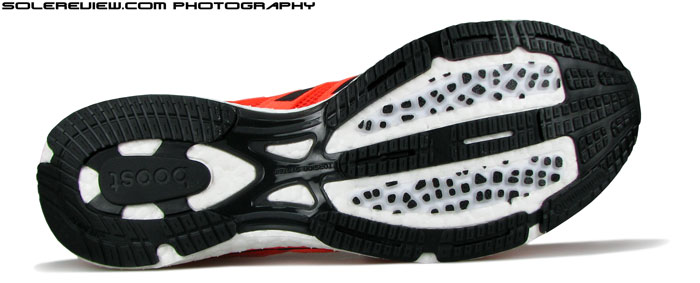
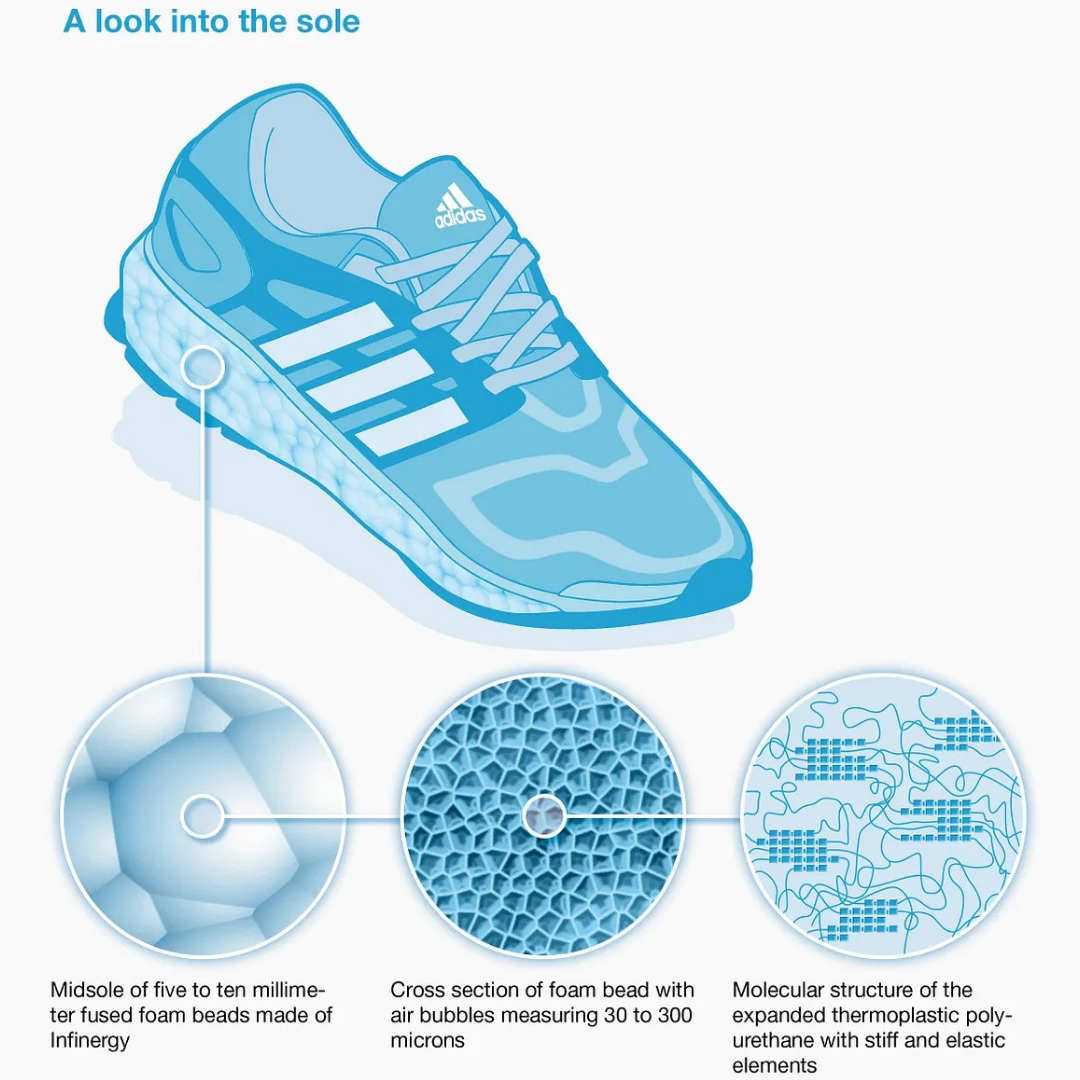
In 2013, Adidas introduced the revolutionary Boost cushioning technology. It uses a thermoplastic polyurethane particles which are expanded to form small closed cells around air pockets. This meant that when compressed, Boost will spring back to its original shape. Boost has similar properties in both cold and hot conditions, and has much greater durability compared with EVA foams used before. What it meant for racing flats is that you could have far better shock absorption for the same midsole stack height. This was the main innovation that Adidas brought to the AdiZero Adios Boost.
There was only the slightest weight penalty over the AdiZero Adios 2, the Boost-equipped successor coming in at 227 grams. Grip was still provided by Continental, with Quickstrike rubber pieces to provide yet more traction. There was also still the 3-tier Torsion System kept the shoe and it’s soft midsole cushioning stable. The upper however saw some revisions from the first version of the AdiZero Adios Boost, with a more breathable mesh upper with suede overlays similar to the AdiZero Adios 2. What it meant was the slightest weight penalty compared with the 220 gram weight of the original AdiZero Adios Boost.
Adidas would later try to push the envelope even further with the Adidas AdiZero Sub2, which you can read more about here, including the earlier dalliances Adidas had with carbon-fibre plate technology.
References:
https://en.wikipedia.org/wiki/Dennis_Kipruto_Kimetto
https://www.runnersworld.com/races-places/a20819227/dennis-kimetto-breaks-world-record-at-berlin-marathon/
https://www.solereview.com/adidas-adizero-adios-boost-2-review/
https://solecollector.com/news/2014/09/marathon-record-set-in-the-adizero-adios-boost